How to Identify Chords by Ear, Step by Step

To identify a chord by ear, work through it in a fixed order: find the bass note, decide whether the chord sounds major or minor, then listen for whether a fourth note has been added on top. Almost every chord you meet in popular music is settled by those three questions, and the ones that are not get caught by two more.
The reason most people stall at this is not talent. It is that they try to hear the whole chord at once, as a single flavour, and then guess. A guess has maybe forty options. A sequence of yes/no questions has four or five. Here is the sequence, and you can hear each step on this page.
That is the same root note four times. If you can hear those four apart, you can already identify most of what you will run into.
The five questions, in order
Run them top to bottom and stop as soon as the chord is pinned down. Most chords are done by question three.
| # | Question | What you are listening for | What it rules in |
|---|---|---|---|
| 1 | What is the lowest note? | The bass, not the melody | The root, usually |
| 2 | Major or minor? | The third: bright or dark | Major vs minor triad |
| 3 | Is it neither? | An open, unresolved sound with no clear third | A sus chord |
| 4 | Is there a fourth note? | Extra colour above the triad | 7th, 6th, add9 |
| 5 | Which number is it in the key? | The chord’s pull toward home | Function, not just spelling |
Questions 1 to 4 tell you what the chord is called. Question 5 is the one that makes the skill transfer to the next song in a different key, and it is the one most guides skip.
Step 1: Find the bass note
The lowest note in the texture is the single most useful piece of information in the chord, and it is the easiest to hear, because nothing is competing with it down there. Bass players and left hands overwhelmingly play the root.
Practically: hum along with the lowest thing you can hear. Not the tune, the thing underneath the tune. Hold the hum, then find that pitch on a keyboard. That is your candidate root.
Two honest caveats. First, the bass sometimes plays a note from the chord that is not the root, which gives you a slash chord like C/E. If your chord sounds like a plain major triad but the bass feels oddly restless underneath it, that is usually what has happened. Second, in dense mixes the bass can be hard to separate. Playing the track through headphones rather than a phone speaker fixes this more often than any amount of extra practice does.
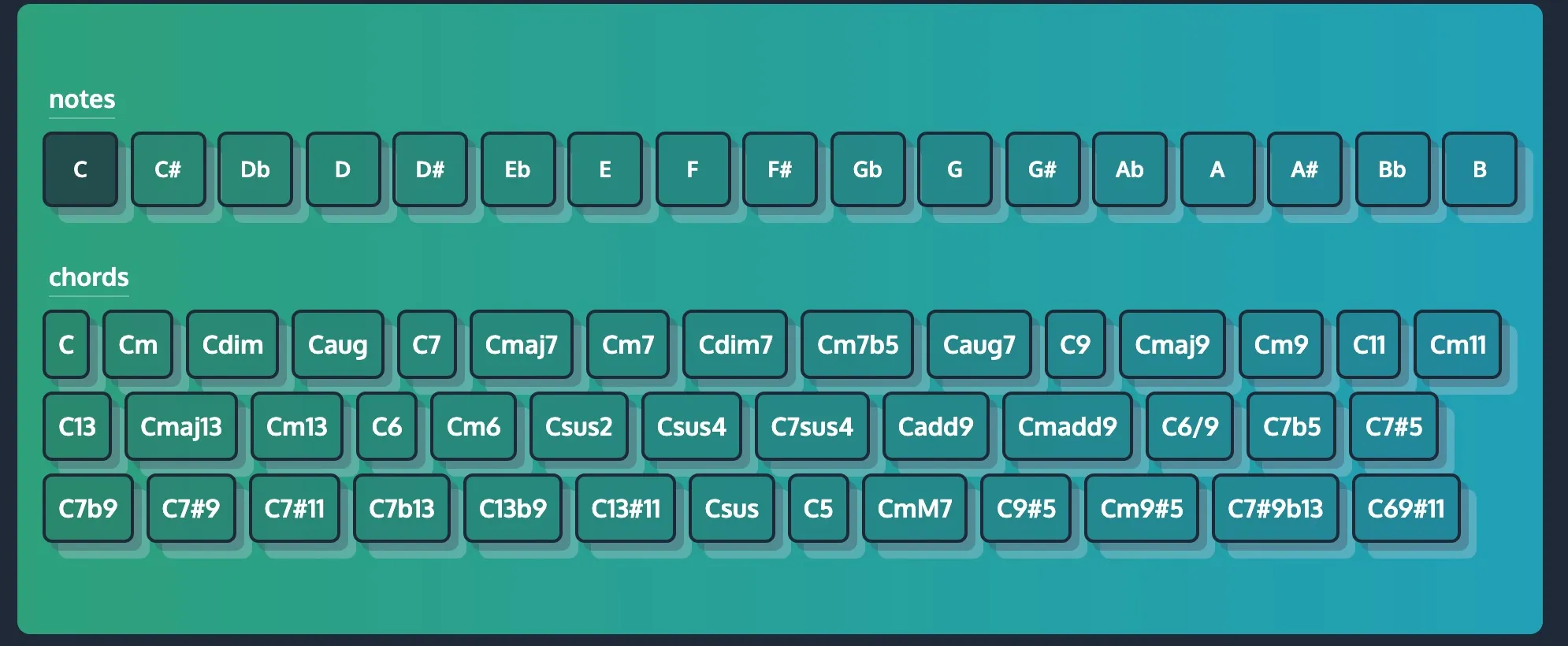
Once you have a candidate root, you have narrowed forty-something chords down to the handful built on that one note. ChordCreate’s chord finder is built exactly around that move: pick the note, then audition every chord that sits on it.
Step 2: Major or minor
One note decides this, and it is the third. In C major the notes are C, E, G. Lower that E by a semitone to Eb and you have C minor. Nothing else changes. (If the theory behind that is new, what a chord actually is covers the construction properly.)
The usual descriptions are “bright” and “dark”, or “happy” and “sad”. They are fine as a starting label but they are not what you should train on, because a slow major chord can sound wistful and a fast minor chord can sound triumphant. Train on the interval instead: the distance from the bass note up to the third is either four semitones or three, and with repetition that gap becomes as recognisable as a familiar voice.
Play these back to back until the switch is obvious without thinking:
A shortcut that works well early on: attach each quality to a song you already know by heart. Pick one major-sounding opening chord and one minor one, and recall them as reference points. It feels like a crutch, and it is, but it is the crutch nearly every good ear started on.
Step 3: If it is neither, check for a missing third
Sometimes the answer to question 2 is “I honestly cannot tell.” That is information, not failure. A chord with no third in it is genuinely neither major nor minor, and the most common version is a sus chord, where the third has been replaced by the note next door.
The Csus4 leans hard and wants to fall into the plain C. The Csus2 is calmer and does not especially need to go anywhere. If a chord sounds open, slightly unfinished, and stubbornly refuses to be classified, sus is the first thing to test. Sus chords, explained properly goes into how each one behaves, including the quirk that every sus2 is also a sus4 built on another note. Csus2 is C, D, G, and so is Gsus4. Same three pitches, different note on the bottom.
The other “neither” cases are rarer but worth knowing by sound: a power chord (root and fifth only, no third at all, the backbone of rock guitar), a diminished chord like Cdim, which sounds tense and unstable, and an augmented chord, which sounds stretched and slightly unreal.
Step 4: Is there a fourth note?
Once you have a major or minor triad, listen for whether something is sitting on top of it. Four-note chords are where beginners most often hear “something extra” without being able to name it, and there are really only three common answers.
| Sound | Chord | Notes on C | Where you hear it |
|---|---|---|---|
| Smooth, dreamy, floating | Cmaj7 | C E G B | Soul, neo-soul, bossa, lofi |
| Warm, mellow, relaxed | Cm7 | C Eb G Bb | House, jazz, R&B |
| Restless, bluesy, wants to move | C7 | C E G Bb | Blues, funk, gospel |
The dominant 7 is the one to learn first, because it is the most distinctive. It does not sound pretty. It sounds like it is about to go somewhere, and that pull is unmistakable once you have noticed it a few times.
Two near-misses worth separating from the 7ths. A 6th chord like C6 is sweet and vintage rather than dreamy. An add9 like Cadd9 keeps the third and adds sparkle above it, which is a very different sound from a sus2 even though both involve the 2nd.
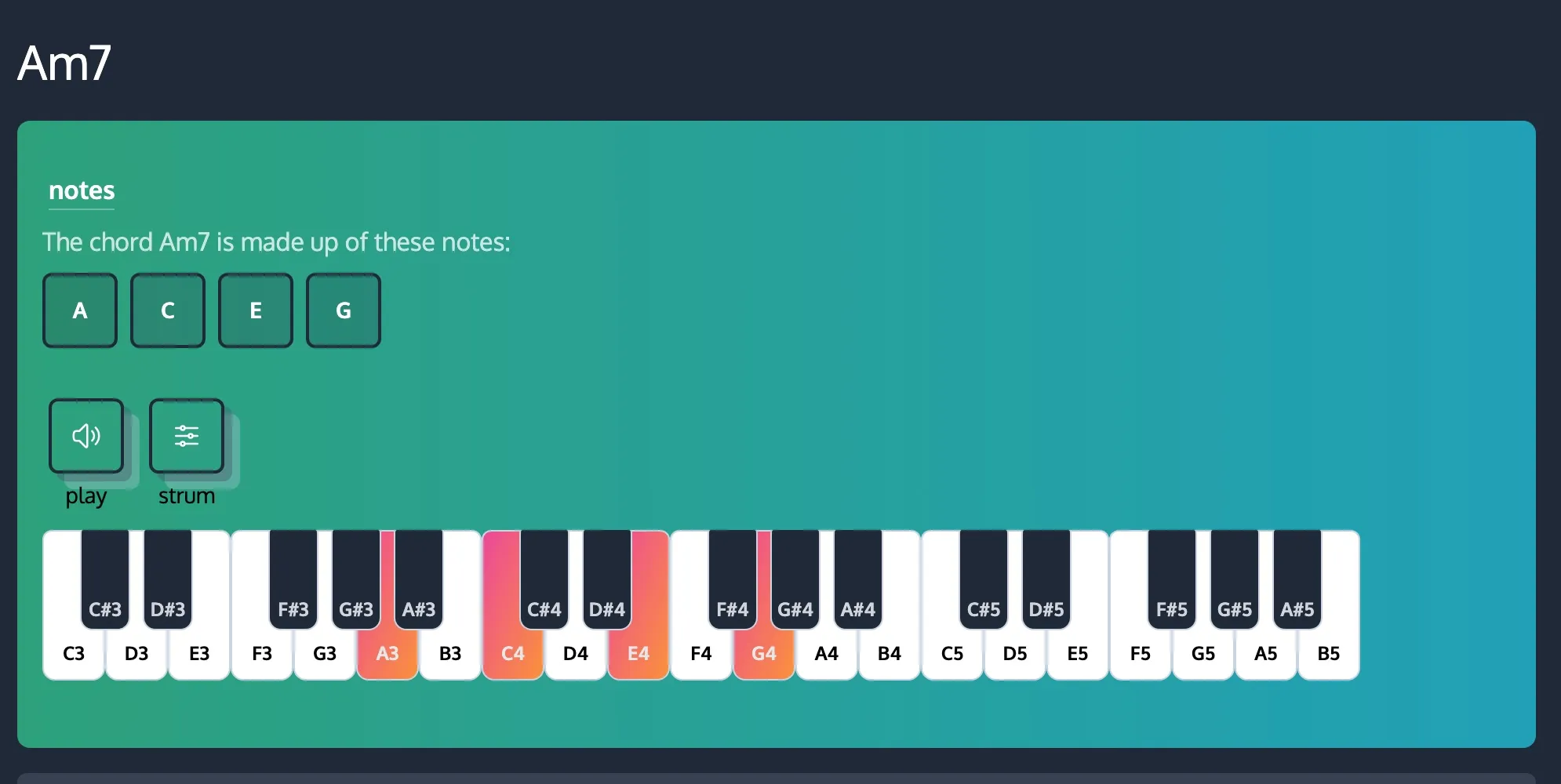
If you get a chord down to its notes and want to check your answer, every chord in ChordCreate has a page showing its exact notes highlighted on a keyboard, with play and strum so you can compare what you guessed against the real thing.
Step 5: Turn the letter into a number
This is the step that separates people who can name a chord from people who can hear music. Instead of stopping at “that is an F”, go one further: “that is the 4 chord, because we are in C.”
Roman numerals do this properly (I, IV, V, vi), but plain numbers work fine while you are learning. The reason it matters is that letters do not transfer and numbers do. The same song in a different key has completely different letters and exactly the same numbers. Learn the numbers and you learn thousands of songs at once, because a startlingly large share of popular music runs on the same handful of numeric patterns.
That is I, V, vi, IV in C. You have heard it several hundred times. The point is not that it is a cliche, the point is that once you can recognise it as a shape rather than as four letters, you will spot it in any key within a bar or two.
Hearing a whole progression
Individual chords are the hard part. Progressions are easier than they look, for two reasons.
The first is that the bass line usually spells them out for you. Follow the lowest note through the whole loop and you have the root of every chord in order, without having identified a single chord quality yet. Descending bass usually means a stepwise walk-down. Bass jumping up by fourths is circle-of-fifths movement, which is everywhere in jazz and older pop.
The second is that the odds are stacked in your favour. Most pop, rock and dance music loops four chords, and those four are drawn from a small pool. Before working anything out from scratch, test the obvious suspects against what you are hearing:
A practical routine: find the key, count how many different chords are in the loop, work out the bass note of each, then apply steps 2 to 4 to whichever chord you are least sure about. You will often find you only had to properly identify one of the four. The rest fall into place because progressions have grammar, not just vocabulary. Six progressions worth knowing by ear covers the patterns that come up most, and sad chord progressions covers the minor-key shapes that trip people up when they are expecting major.
How to practise this without a teacher
Short and daily beats long and occasional. Ten focused minutes will do more than an hour on Sunday.
- Isolate one variable. A week on major versus minor only. Then a week on adding the dominant 7. Trying to learn all chord qualities at once is why most people quit.
- Test yourself before you check. Guess out loud, then verify. The moment of being wrong is where the learning happens, so do not skip straight to the answer.
- Use songs you know, not exercise files. Pick a track you love but have never learned, listen to the first verse once without an instrument, then work it out. Familiar music gives your ear something to hold onto.
- Sing the bass line. Singing forces you to actually hear the pitch rather than pattern-match it. It is the single most effective drill on this list and the one people are most reluctant to do.
- Work with a reference instrument in front of you. A virtual piano is enough. You need something to check your guess against immediately, while the sound is still in your head.
Expect real progress in weeks, not days. Recognising major from minor reliably takes most people a few weeks of short daily sessions. Hearing 7ths reliably takes longer, and hearing extensions in a full mix is a genuinely advanced skill. That is normal.
When you can hear it but cannot name it
There is a whole category of tool that claims to solve this by listening to a recording and printing the chords. Those are audio-detection products, and they are a different thing from what is on this page. ChordCreate does not transcribe audio: its tools go the other way, from a chord name or a prompt to the sound. What people actually mean by “chord finder” separates the three meanings honestly, including which ones this site serves and which it does not.
Worth saying plainly, though: an automatic transcription is a shortcut, not a substitute. It tells you the answer to one song. The five questions above tell you the answer to every song after this one.
Quick answers
How do I identify a chord by ear? Find the lowest note to get the root, decide whether the chord sounds major or minor by listening to the third, then listen for whether a fourth note has been added on top. Stop as soon as the chord is pinned down.
What should I listen for first in a chord? The bass note. It is the easiest note to hear because nothing else is competing in that range, and it is the root of the chord most of the time.
How can I tell a major chord from a minor chord by ear? One note separates them, the third. Major sounds brighter, minor darker, but train on the interval rather than the mood, since tempo and arrangement can make a major chord sound sad.
How long does it take to identify chords by ear? Most people can tell major from minor reliably after a few weeks of short daily practice. Hearing 7th chords and extensions in a full mix takes considerably longer and is a normal thing to find hard.
Can I identify a chord progression without identifying every chord? Usually, yes. Follow the bass line to get the root of each chord, then check the loop against the common four-chord patterns. Often only one chord actually needs working out from scratch.
Do I need perfect pitch to identify chords by ear? No. This is relative pitch, which is a trained skill rather than an inborn one. You are comparing notes to each other and to the key, not naming pitches out of thin air.